
Imagine ordering groceries from your local kirana store, discovering a handmade saree from a rural artisan, or buying electronics — all without being locked into one giant platform’s rules, high fees, or search algorithms. That’s the promise of ONDC, India’s bold government-backed experiment. On the other side stands Amazon India, the polished, customer-obsessed giant that taught millions of Indians to shop online.
In 2026, these two forces represent very different visions for the future of e-commerce: one open and decentralized, the other powerful and centralized. For the average Indian buyer or small seller, understanding this clash matters — because it will shape prices, choices, and opportunities in the years ahead.
What is ONDC?
The Open Network for Digital Commerce (ONDC) is not another shopping app. It is a protocol — like UPI for payments — that allows different buyer and seller apps to connect seamlessly.
Launched by the Department for Promotion of Industry and Internal Trade (DPIIT), ONDC aims to democratize digital commerce. Sellers register once on any compatible seller app and become visible across multiple buyer apps. Buyers can discover products from thousands of small businesses without visiting a single dominant platform.
As of mid-2026, ONDC has:
- Over 7 lakh sellers onboarded
- Presence in 1,200+ cities and towns
- More than 150 million cumulative transactions
- Strong growth in grocery, food & beverages, and local services
Amazon India: The Established Powerhouse
Amazon entered India in 2013 and quickly became one of the top two players alongside Flipkart. It offers a slick, reliable experience with Prime delivery, a vast selection, customer reviews, and strong logistics.
Amazon handles tens of millions of orders daily and dominates in categories like electronics, fashion, and books. Its customer base is urban and semi-urban, and its brand trust is extremely high.
Head-to-Head Comparison
For Sellers
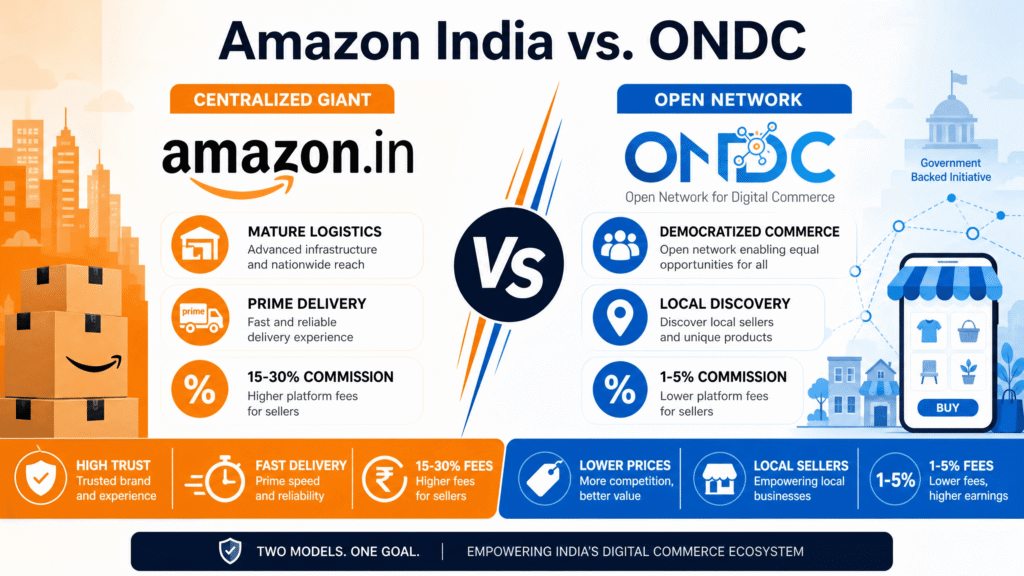
- Commissions: ONDC charges 1-5% (sometimes as low as 1-3% protocol fee), while Amazon typically takes 15-30% plus other fees.
- Control: ONDC gives sellers higher control over pricing, customer data, and branding. Amazon controls search visibility and can promote its own private labels.
- Onboarding: ONDC is faster (1-2 days) and cheaper. Amazon requires more time and often advertising spend to get noticed.
- Reach: Amazon offers massive built-in traffic. ONDC’s reach is growing but still depends on multiple apps.
For Buyers
- Choice and Price: ONDC often delivers lower prices because of reduced commissions passed on to customers. You can compare the same product across different sellers easily.
- Convenience: Amazon wins with faster delivery, easy returns, and a single trusted app experience.
- Discovery: ONDC promotes local and small sellers; Amazon excels at personalized recommendations.
Logistics and Scale Amazon has a mature logistics network. ONDC relies on a network of partners, which is flexible but sometimes less consistent. Amazon has integrated some logistics services into ONDC, showing it is both competitor and participant.
Current Scale: Still David vs Goliath
Despite impressive growth, ONDC’s daily order volume (around 2.87 lakh) remains far below Amazon India and Flipkart (each over 22 lakh orders per day).
However, ONDC is growing rapidly in Tier-2 and Tier-3 cities, where small businesses and local retailers are embracing it.
Quote from industry analysis: “ONDC does not seek to replace Amazon or Flipkart. It seeks to add a layer of interoperability so smaller players can compete.”
Challenges for ONDC
- Lower brand awareness among average users
- Inconsistent delivery experience across partner apps
- Slower adoption in premium urban segments
- Need for better buyer apps to compete with Amazon’s polish
Amazon’s Strategy
Amazon has smartly joined ONDC as a logistics and technology partner rather than fighting it outright. This allows the company to expand its reach while protecting its core marketplace business.
Who Wins in Different Scenarios?
- Small sellers and artisans: ONDC is often better due to lower costs and fairer visibility.
- Large brands and quick scale: Amazon still offers unmatched reach and tools.
- Price-conscious buyers: ONDC networks frequently deliver better deals.
- Convenience seekers: Amazon remains the go-to.
The Bigger Picture
ONDC is part of India’s Digital Public Infrastructure push — similar to UPI’s success in payments. If it scales successfully, it could prevent monopoly control, boost small businesses, and bring millions more Indians into formal digital commerce. Amazon continues to invest heavily and innovate, keeping competitive pressure high.
Actionable Takeaway
If you’re a seller, test ONDC alongside Amazon. Start with low-volume products to compare margins and customer acquisition. Use tools like seller apps on ONDC for quick onboarding.
If you’re a buyer, download a couple of ONDC-enabled apps (like those for groceries or local stores) and compare prices with Amazon for your regular purchases. You might save money while supporting local businesses.
Thought-provoking question: Can an open network like ONDC truly challenge the convenience and trust that Amazon has built over a decade, or will most Indians continue preferring the familiar giant even if it costs them more? The next few years of growth will decide whether India’s e-commerce future becomes more democratic — or remains dominated by a few powerful players.