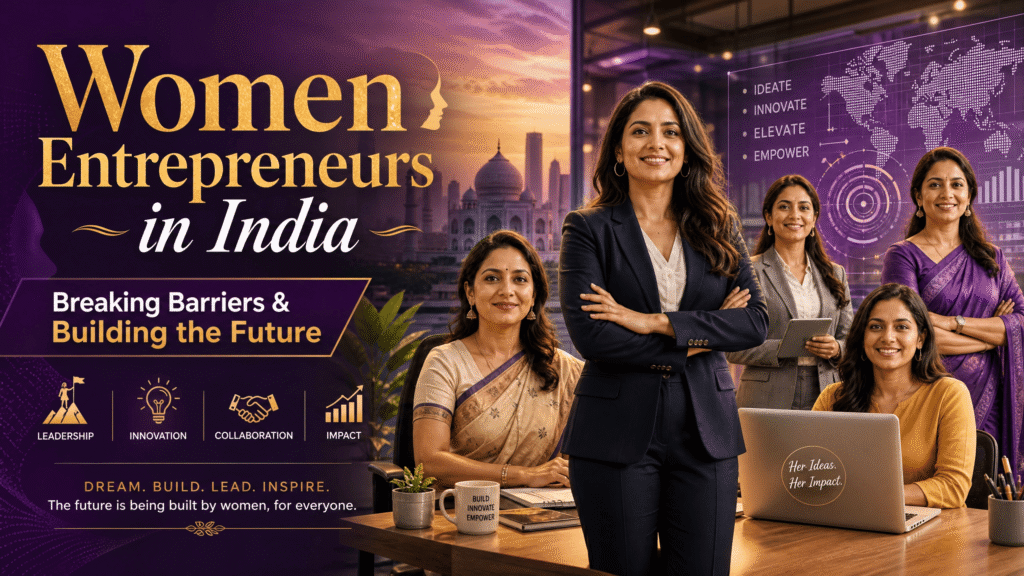

She started a small beauty brand from her kitchen table and turned it into a multi-crore empire. Another left a high-paying corporate job to solve a painful problem for millions of women. These aren’t rare exceptions anymore. Across India in 2026, women entrepreneurs are quietly — and sometimes loudly — reshaping industries from beauty and health to fintech, sustainability, and deep tech.
For the average Indian, this rise matters. It means more innovative products tailored to real needs, more jobs in local communities, and a powerful example that ambition has no gender.
The Current Picture: Steady Growth with Huge Potential
Women now lead around 14-20% of businesses in India, including a significant share of MSMEs. In the first quarter of 2026 alone, women-led startups raised over ₹2,900 crore. While this is still far below their male counterparts, the momentum is unmistakable.
Women entrepreneurs are particularly strong in:
- Beauty & personal care
- Health & wellness
- Education & edtech
- Sustainable fashion and handicrafts
- Fintech and consumer services
Key Statistic: Women-led startups have the potential to create 150–170 million jobs by 2030 and add hundreds of billions to India’s GDP.
Inspiring Success Stories
Several women have become household names and role models:
- Falguni Nayar — Founder of Nykaa, turned a passion for beauty into one of India’s biggest e-commerce success stories.
- Ghazal Alagh — Co-founder of Mamaearth, built a clean beauty brand that went public and redefined standards for Indian parents.
- Vineeta Singh — Co-founder of SUGAR Cosmetics, a bootstrapped success story that challenged big players in the lipstick and makeup market.
- Aditi Gupta — Created Menstrupedia, a simple, stigma-breaking guide to menstruation that has educated millions.
These women represent both urban tech founders and those scaling traditional crafts into modern businesses.
Government Support: New Schemes in 2026
The government has rolled out several initiatives to accelerate this wave:
- SHE-MART (Self Help Entrepreneur Marts): Announced in Union Budget 2026-27 — community-owned retail outlets run by women self-help groups to sell their products directly.
- Lakhpati Didi 2.0: Aims to create 3 crore financially independent women by 2027 through skill training and entrepreneurship.
- Stand-Up India, Mudra Yojana, and Women Entrepreneurship Platform (WEP): Provide easier loans, mentoring, and market access.
These programs focus on rural and semi-urban women, helping turn self-help groups into real enterprises.
Persistent Challenges
Despite the progress, hurdles remain real:
- Funding Gap: Women-led startups receive a disproportionately small share of venture capital.
- Social and Family Pressures: Balancing business with household responsibilities is still tough for many.
- Networking and Mentorship: Male-dominated investor circles and industry events can feel exclusionary.
- Access to Markets: Scaling beyond local areas remains difficult without strong digital and logistics support.
The Road Ahead
In 2026, the conversation has shifted from “Can women do it?” to “How do we remove the remaining obstacles?” Digital tools, UPI payments, and social media have lowered entry barriers dramatically. Sustainability-focused and impact-driven businesses led by women are particularly gaining attention from global investors.
Actionable Takeaway
If you’re a woman thinking of starting a business: Begin small, validate your idea locally, and register on government platforms like Startup India or myScheme.gov.in. Explore schemes like Mudra loans or SHE-MART for initial support. Join women entrepreneur networks for mentorship and peer learning. Even if you’re not starting a company, support women-led brands in your daily purchases — your choices create demand and opportunity.
Thought-provoking question: India has the world’s largest working-age population and millions of talented, educated women — yet female labor force participation and entrepreneurship rates still lag. As more women break through in 2026 and beyond, will society and institutions fully back this shift, or will outdated mindsets continue to hold back both women and the nation’s economic potential? The answer will shape India’s story for the next decade.