
Picture this: A 19-year-old entrepreneur starts a small budget hotel booking company from his hostel room. Fast forward to 2026, and that company — OYO — is on the verge of going public in one of India’s most anticipated IPOs. For millions of travelers who’ve stayed in an OYO room and investors watching India’s startup story, this moment feels historic.
After multiple delays and false starts since 2021, OYO’s parent company Prism (formerly Oravel Stays) has received SEBI approval and is gearing up for a market listing in the second half of 2026. Here’s everything the average Indian investor or traveler needs to know.
The Journey of OYO: From Startup to Global Player
Founded in 2013 by Ritesh Agarwal, OYO began by standardizing budget hotels across India. It quickly expanded into a tech-enabled hospitality platform that partners with property owners to offer affordable, consistent stays.
At its peak, OYO was valued at over $10 billion. It faced major challenges during the COVID-19 pandemic, massive losses, and heavy criticism over its business model. But the company has staged a strong comeback by focusing on profitability, premium properties, and international expansion — including the high-profile acquisition of Motel 6 in the US.
Current IPO Status (June 2026)
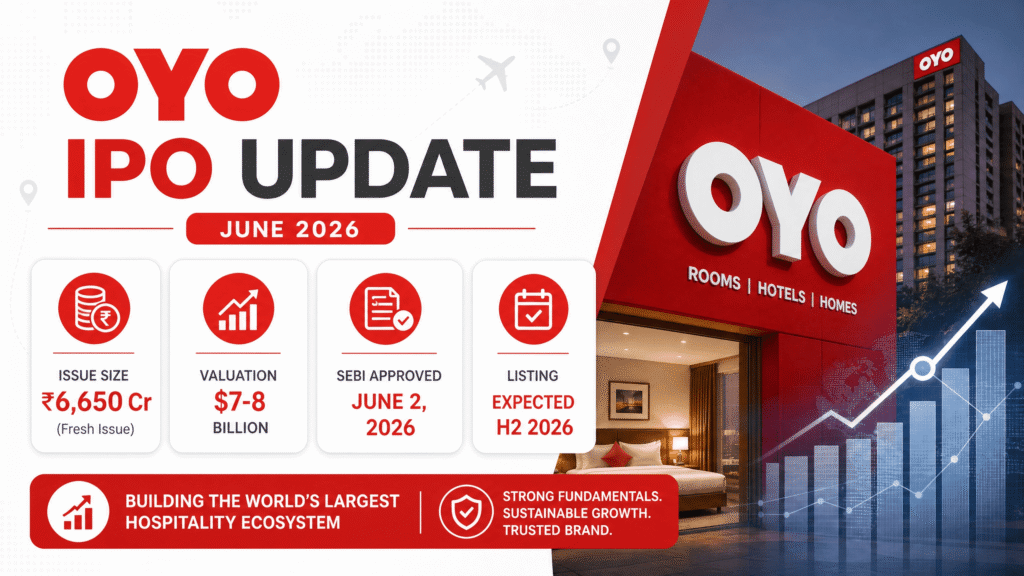
- Issue Size: ₹6,650 crore (down from earlier plans of ₹8,400+ crore) — entirely a fresh issue (new shares to raise capital for the company).
- Target Valuation: $7–8 billion.
- SEBI Approval: Received on June 2, 2026.
- Next Steps: Updated draft prospectus expected in early July 2026, with a possible listing in the second half of 2026.
- Purpose of Funds: Expansion, technology upgrades, debt reduction, and global growth.
Recent Update: “OYO’s parent company is expected to receive final approval from Securities and Exchange Board of India for its IPO this week,” noted market observers in early June 2026.
Financial Turnaround: The Key Story
OYO has shown strong improvement:
- Turned profitable with net profit exceeding ₹200 crore in Q1 FY2026 (more than double the previous year).
- Revenue grew 47% to ₹2,019 crore in the same quarter.
- Shift to an asset-light model and focus on higher-margin premium hotels have driven better economics.
This profitability is crucial — investors are now more confident compared to earlier attempts when the company was burning cash heavily.
What Makes OYO’s IPO Different?
- Fresh Issue Focus: Unlike many IPOs with big offer-for-sale (OFS) components where promoters sell shares, this is primarily to raise growth capital for OYO itself.
- Global Ambitions: Funds will support international operations beyond India and China.
- Market Context: Comes at a time when Indian markets are receptive to well-prepared tech and consumer plays.
Risks and Challenges Investors Should Know
- High Competition: From hotel chains like Marriott, Accor, and local players like FabHotels and Treebo.
- Debt Levels: Though improving, past borrowings remain a concern.
- Execution Risk: Managing thousands of partner hotels across countries is complex.
- Valuation Debate: At $7–8 billion, is it reasonable compared to its $10 billion+ peak? Market conditions at listing will decide the final pricing.
Who Should Watch This IPO?
- Retail Investors: Looking for exposure to India’s travel and hospitality recovery.
- Long-term Believers: In Ritesh Agarwal’s vision of tech-driven hospitality.
- Travel Enthusiasts: Who want to own a piece of the platform they use regularly.
Actionable Takeaway
Keep a close eye on the updated DRHP filing expected in July 2026. Review OYO’s financials, growth metrics, and risk factors carefully before applying. Consider your risk appetite — IPOs can be volatile in the short term but rewarding for believers in the long-term story. Use reliable brokerage apps and consult a financial advisor if needed. Start small if you decide to participate.
Thought-provoking question: After years of losses and near-misses, OYO has finally turned profitable and secured SEBI nod for its IPO. Can Ritesh Agarwal’s company deliver consistent returns to public shareholders the same way it disrupted India’s hotel industry, or will the complexities of global hospitality prove too challenging in the public market spotlight? The coming months will reveal whether this unicorn’s listing becomes a fairy tale ending or a new chapter of tests.